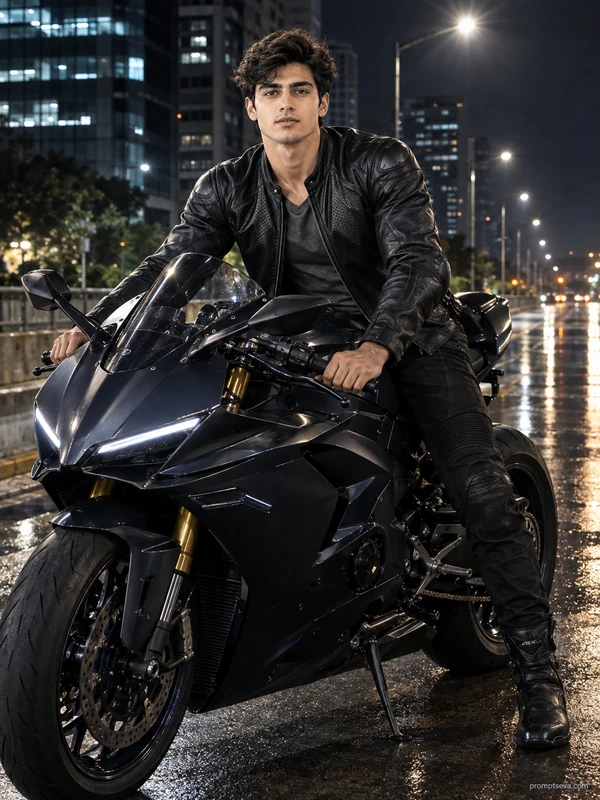
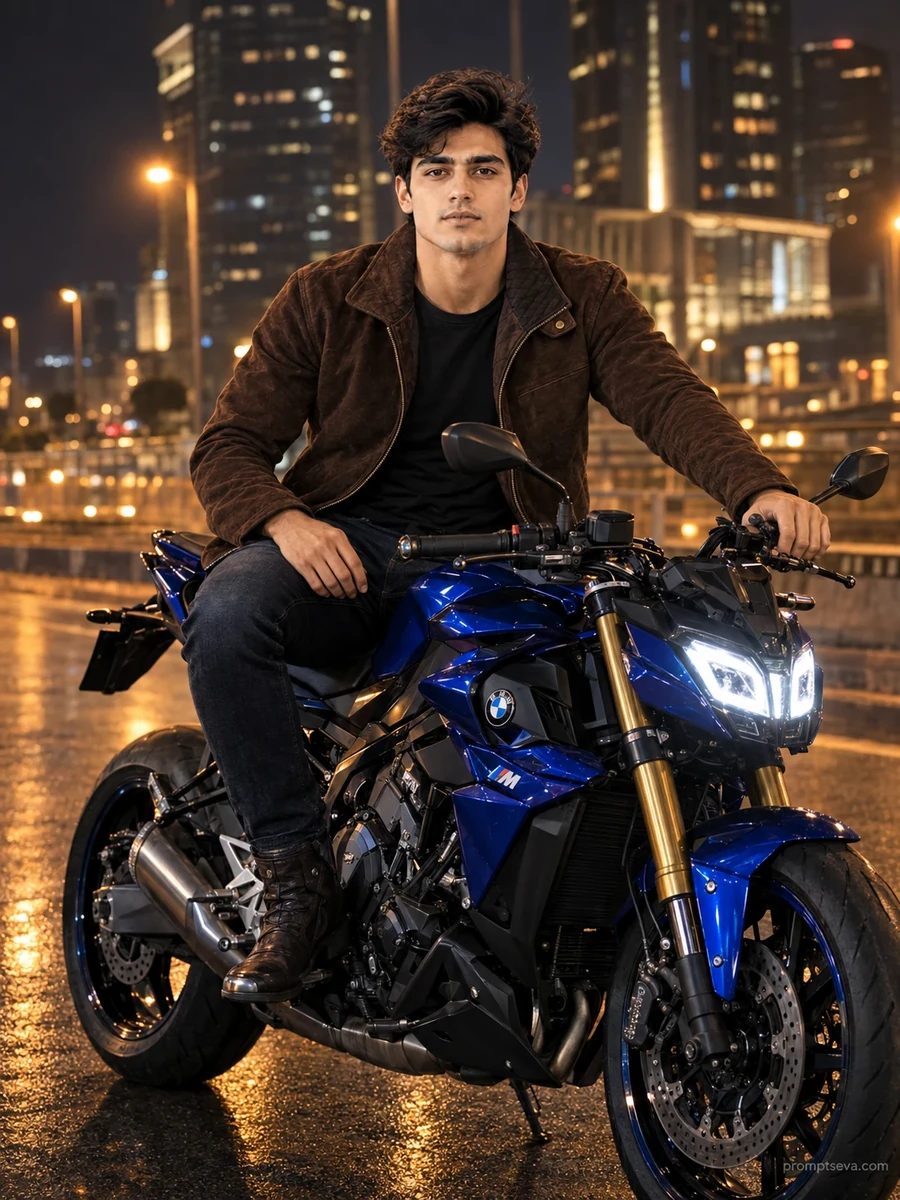
Night motorcycle photography has a specific look when it's done well — moody, a little cinematic, light coming from limited sources rather than flooding the whole scene. This prompt goes for that directly, seated on a metallic blue naked sport bike under sodium vapor streetlights, that warm amber glow you get from older-style city lighting rather than the harsher white LED look.
What's notable here is the lighting temperature detail — 2700K for the streetlights, 6000K for the bike's LED headlight. Those aren't arbitrary numbers; they're describing a genuine color contrast between warm ambient light and cooler artificial light from the bike itself, which is the kind of mixed-lighting complexity that's harder for AI tools to render convincingly than a single, consistent light source.
The pose leans into a leaned-forward stance, roughly fifteen degrees, one foot grounded and the other on the footpeg — meant to read as confident but relaxed rather than aggressive. If the posture comes out looking stiffer or more forced than that description suggests, it's worth asking for "a more relaxed lean, weight naturally settled rather than posed."
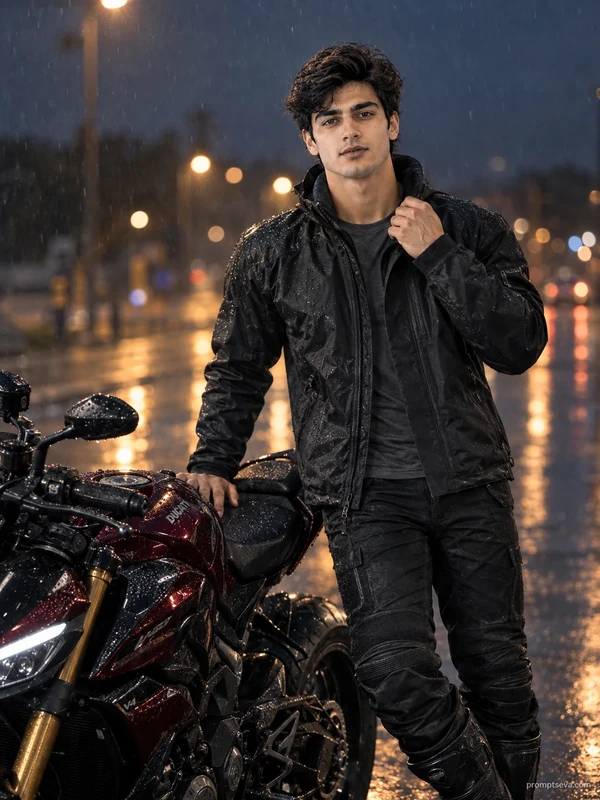
This is a solid pick if you want something with real atmosphere without going as dark or moody as the still rider rain prompt later in this collection — it's night, but it's warm rather than bleak. Good for a profile photo or reel cover where you want some visual interest beyond a flat daylight shot.
As with any night scene in this broader set of prompts, expect the skin tone rendering to need a closer look than it would in daylight. The prompt specifically calls for "true natural skin tones" to be preserved despite the mixed warm and cool lighting, and that's a genuinely harder thing for a model to get right than it sounds — if the skin looks a bit too warm or too cool compared to your actual tone, that's worth a direct correction.
The metallic blue paint on the naked sport bike is worth a specific mention too, since "liquid metal" is doing a lot of work in that description — it's asking for a paint finish with real depth and reflectivity rather than a flat, matte blue. If the bike's bodywork looks dull or single-toned in the result, a follow-up like "more reflective, liquid-metal quality to the blue paint, catching more of the ambient street light" tends to bring back that intended shine without needing to redo the whole scene.
It's worth comparing this prompt against the still rider rain scene later in the collection, since both lean into moody, low-light atmospheres but arrive there differently — this one through warm sodium streetlights and a cool LED headlight working against each other, the rain prompt through wet reflective surfaces and mist. If you're trying to judge how versatile a given AI tool is with night photography specifically, generating both and comparing is more informative than judging either one in isolation, since the two scenes ask for genuinely different technical solutions to a similar overall mood.
The pompadour hairstyle with a tight fade is also worth a second look, since fades in particular are a haircut detail that AI models sometimes soften into a more generic short cut rather than rendering the sharp, defined line where the fade meets the top length. If the haircut reads as a plain short cut instead of a proper fade, "sharper contrast line where the fade meets the top, more defined pompadour shape" is a useful, specific correction.
The glass-and-steel buildings softly visible in the distance are worth a quick check as well, since background architecture at night is another area where AI tools sometimes introduce odd, repetitive window patterns if left unguided. A skyline that looks slightly too uniform or grid-like, rather than naturally varied in window lighting, is worth flagging with something like "more natural variation in the lit windows across the background buildings" if it stands out enough to distract from the main subject.
And because this scene depends on two separate light sources reading as genuinely different in both color and intensity, it's a reasonable one to use as a stress test if you're comparing two different AI tools side by side for night photography work specifically. A tool that keeps the streetlight glow and the bike's own headlight visually distinct, rather than blending them into one generic warm wash, is generally going to handle the more complex mixed-lighting prompts elsewhere in this broader collection more reliably too.