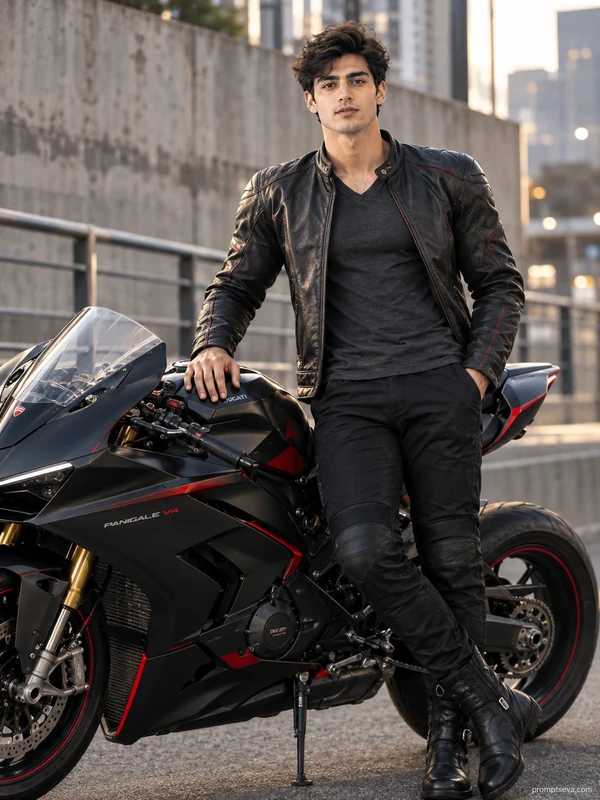
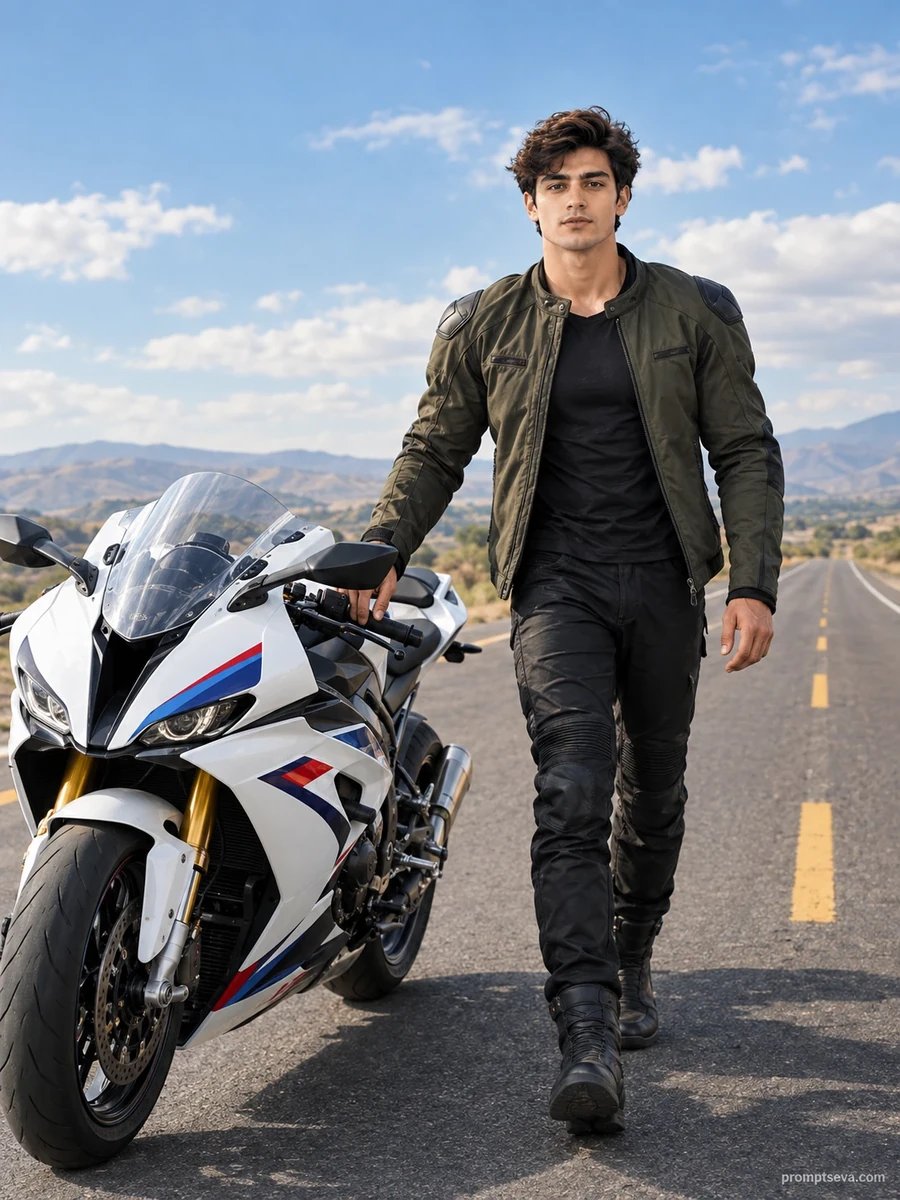
Most of the prompts in this collection put you standing still next to a bike. This one has you walking beside it instead, guiding it forward along an open national highway, wide-angle framing that makes the road feel like it stretches on forever. It's meant to feel like scale and freedom rather than a posed portrait.
Walking poses are consistently one of the harder things for AI image tools to get right, and this prompt is honest about that complexity in how much detail it puts into describing the stride — left foot forward, right foot pushing off behind, natural asymmetry rather than a frozen, symmetrical walking cliché. Don't expect this to land perfectly on the first attempt; it's genuinely one of the more demanding prompts in the whole set to get looking authentic rather than stiff.
The wide-angle lens choice (35mm rather than the 50mm or 85mm used elsewhere in this collection) is doing real compositional work here — it's what creates that sense of epic, sprawling scale along the highway. If you want a tighter, more intimate feel instead, that's a different prompt in this collection to reach for rather than trying to force this one into a different mood.
This works well if you want something with genuine motion and energy — good for an adventure or travel-themed profile, less right if you want a composed, formal-feeling image. The still, standing poses in the luxury street portrait or garage prompts elsewhere in this collection will serve that need better.
Given how much is being asked of the model here — walking motion, wide landscape, facial accuracy, all at once — it's worth budgeting for at least one or two rounds of adjustment. If the stride looks unnatural or frozen, "more natural walking motion, less posed" is a more useful follow-up than trying to redescribe the whole scene from scratch.
The 35mm wide-angle lens choice is worth understanding on its own, separate from the walking motion itself, since it's a meaningfully different tool than the 50mm and 85mm lenses used in most of the other prompts across this site. A wider lens captures more of the surrounding landscape relative to the subject, which is exactly what gives this shot its sense of epic, open-road scale, but it also means the subject occupies less of the actual frame than in a tighter portrait lens shot. If you're used to the more face-forward results from other prompts in this collection and this one feels like it's giving less prominence to the face, that's the lens doing its job correctly rather than a face-accuracy problem — it's worth judging the face on its own merits by zooming in rather than by how large it appears in the initial frame.
This is also a good prompt to generate specifically if you want to test how well an AI tool handles a genuinely empty, minimal-distraction highway, since the prompt is explicit about wanting "absolutely no traffic distraction." If unwanted vehicles or people show up in the background despite that instruction, that's a useful signal about how closely a given tool is actually reading detailed negative-space instructions versus just generating a generic highway scene by default.
The rolling hills and muted earth-tone landscape in the background are also worth a look on their own terms, since they're doing quieter compositional work than the road itself but still shape the overall feel of the image. If the landscape renders as flat or featureless rather than gently varied, a follow-up like "more visible texture and gentle elevation change in the hills along the horizon" adds depth without competing with the walking figure in the foreground.
The fresh yellow center line markings on the asphalt are a small compositional anchor worth noting too, since a clean, unbroken line running into the distance reinforces the sense of scale the wide-angle lens is already working to create. If the road markings come out faded, broken, or missing entirely, restoring them with a direct note tends to sharpen the overall sense of an open, endless highway more than any adjustment to the landscape or lighting would.
If you're generating multiple prompts from this Gemini 2026 collection for a single content set, this walking shot works best as a mid-sequence change of pace rather than an opener or closer — it introduces genuine motion into a group of otherwise mostly static, confident-stance images, and that contrast reads more intentionally when it interrupts a run of stillness rather than starting or ending the sequence.