
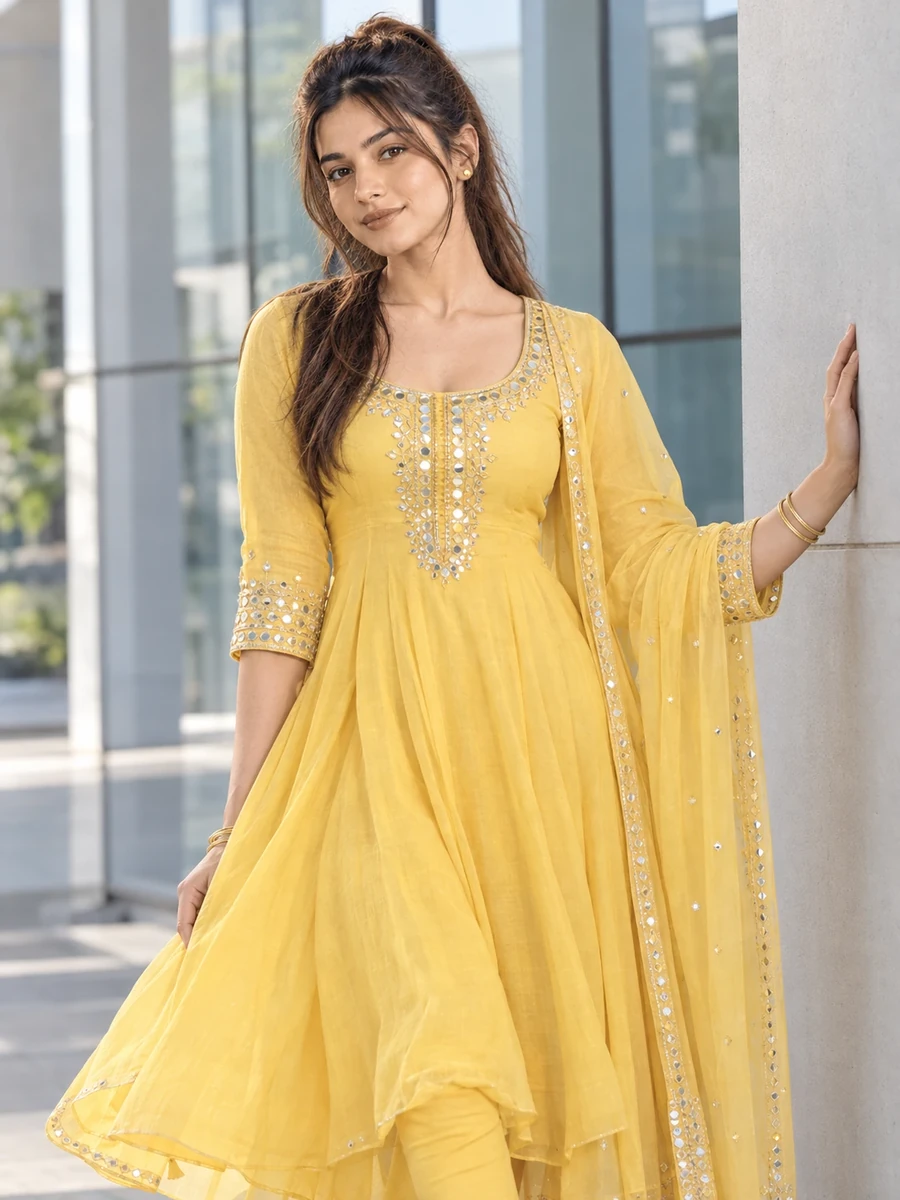
This photo prompt turns an ordinary photo into a clean, editorial-style portrait against a modern building facade in a single generation. You get the same crisp daytime look shown above with no editing skills needed. It leans on a yellow anarkali kurti and bright, even daylight to create a fresh, contemporary frame.
What this prompt creates
The instruction places the subject against a glass-and-concrete facade, one hand lightly touching the wall, with the kurti's flare catching a light breeze. It's a vertical 3:4 portrait shot at eye level with a shallow depth of field, so the architectural lines behind her blur into soft geometric shapes rather than distracting detail. At around 170 words, the prompt is compact and precise about the light and setting, leaving finer posing details for the model to interpret. The result stays recognisably you throughout, since the source photo drives the likeness, not the prompt wording.
How to use this photo prompt
1. Tap Copy prompt above to copy the full text. 2. Open ChatGPT or Gemini and start a new chat. 3. Upload a clear, front-facing photo of yourself. 4. Paste the prompt and send it. 5. If the first result isn't quite right, regenerate once or twice — small wording changes shift the crispness of the light noticeably.
Tips for a better result
- Start from a bright, well-lit reference photo, since the model can only preserve detail it can actually see.
- Leave headroom in your original photo — the output favours a vertical portrait crop, not a tight square.
- If the facade looks too busy, simplify it to "pale concrete and glass panels, softly blurred" so it stays background texture.
- Change one variable at a time — kurti colour, breeze intensity, or pose — instead of rewriting the whole prompt.
- Run the generation twice. Image models are random by nature, and a second attempt is often more crisply lit than the first.
- Start from your highest-resolution photo, since fine embroidery detail depends on how much the model has to work with.
Who this prompt suits
This prompt suits girls who want a fresh, daytime portrait with a modern, urban feel rather than a traditional festive backdrop. It works well as an Instagram post, a profile picture, or a WhatsApp DP, and reads clearly on both phone and desktop screens.
Modern facade backdrops like this one also work well for profile refreshes, since the clean lines stay in style regardless of season or festival.
More prompts like this
Staying in the same kurti set, try the Red Kurti AI Photo Prompt for Girls for a stone-ledge setting, the Plum Anarkali Kurti AI Photo Prompt for a moodier indoor look, the Fuchsia Sharara AI Photo Prompt for Girls for a bold colour choice, and the Dusty Pink Sharara AI Photo Prompt for a softer staircase scene. Browse the full Prompts for Girls collection for more, and visit the PromptSeva homepage for the newest prompts added to the site. If you'd rather try a different city backdrop, a similar composition also works well swapped onto a plain painted wall or a quiet street corner.
It also travels well beyond a phone feed — the crisp, architectural mood suits a LinkedIn-style profile photo or a portfolio image just as easily as a casual post, which is unusual for a festive-leaning prompt set.
What makes this style work
Three specific choices carry this look. The lighting is described precisely — bright, even daylight with a soft directional shadow — rather than left vague, which is what gives the image its crisp, editorial tone instead of a flat snapshot look. The framing and camera position are stated up front (eye level, vertical 3:4, shallow depth of field), which keeps the facade as a clean backdrop rather than a busy distraction. And naming the breeze effect on the fabric directly adds a touch of movement that a static pose alone wouldn't produce.
You can reuse this same structure for your own prompt ideas: subject and styling first, then setting, then lighting and camera, then a short negative list. Keeping that order is what makes a prompt behave predictably across regenerations instead of producing a different result every time you run it.