The prompt
FACIAL IDENTITY — ABSOLUTE PRIORITY
Keep the uploaded person's face completely unchanged: same bone structure, same eyes, same nose, same lips, same skin tone and texture. Do not slim, smooth, beautify, reconstruct, or reinterpret the face. Do not turn them into a celebrity or generic model. 100% face match to the reference photo — only the outfit, pose, background, and gaze direction change, never the face itself.

CAMERA-FACING ANGLE & DIRECT EYE CONTACT (critical)
Face stays fully forward and centered toward the camera, head level, not tilted or turned away — even during an action pose (riding, walking, holding something). The action comes from the hands, shoulders, and body only, never from turning the head or face.

Both people's pupils are centered and looking straight into the camera lens — direct eye contact with the viewer, like a portrait photographer's direct-gaze shot. Not gazing to the side, not looking past the camera into the distance, not unfocused, not cross-eyed. Even if the uploaded reference photo shows the eyes looking elsewhere (to the side, downward, at each other), redirect the gaze so both people look straight into the camera in the final result — this is the one detail that is allowed to differ from the reference photo.

HAIRSTYLE
Hair is neatly styled and groomed for the scene — flyaways smoothed down, settled, not messy or windblown. Applies to both the man and the woman.

MAKEUP (for female subjects)
Light, natural, everyday makeup — subtle base, softly defined brows, a natural lip tint, and a healthy glow. For male subjects: neatly groomed hair and clean natural skin texture, no visible makeup.

CLEAR SKIN (both subjects)
Both people's skin is clear and even-toned — pimples, acne, blemishes, and dark spots are smoothed away naturally, while keeping real, natural skin texture (visible pores, no plastic or airbrushed look). This applies equally to the man and the woman.

IMPORTANT: This grooming, makeup, skin-clearing, and gaze-redirect enhancement must never change face shape, eyes, nose, lips, or bone structure — it only enhances the existing face and gaze direction, it does not alter identity.

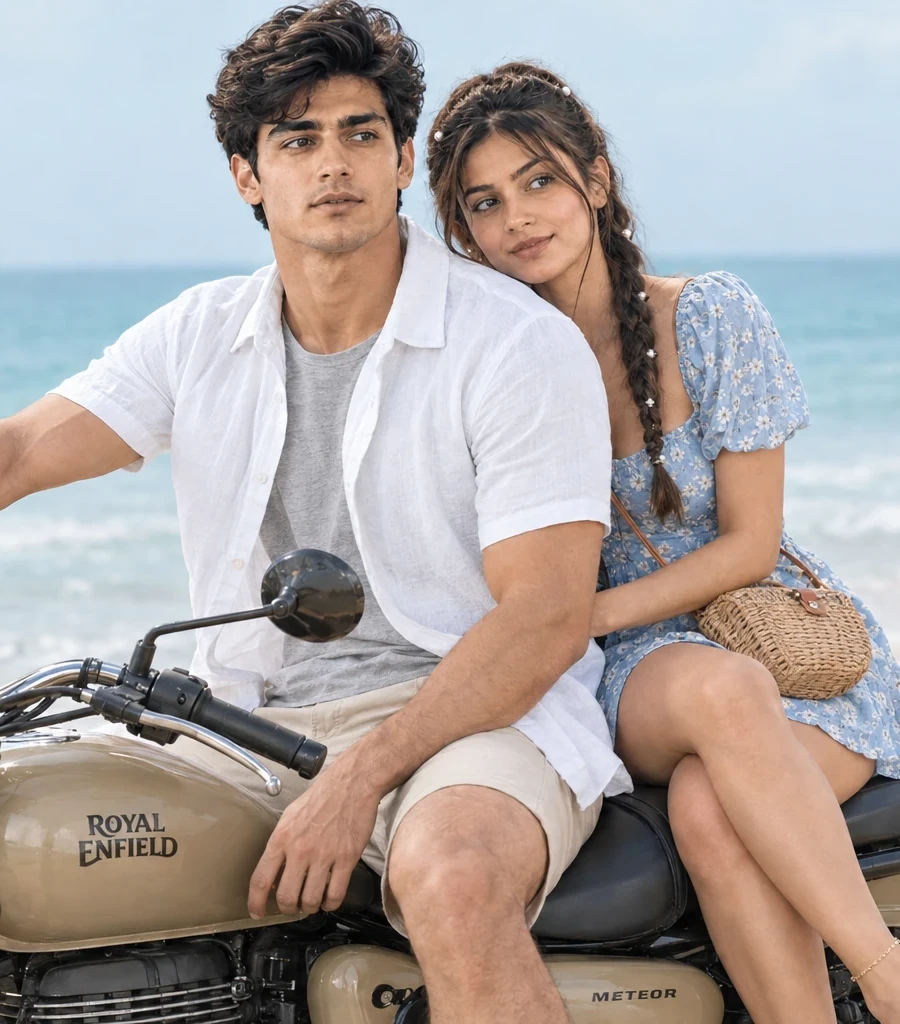
A wide open beach stretches behind them, pale sand fading into turquoise water under a bright clear midday sky. The couple is seated on a vintage sand-coloured Royal Enfield Meteor, parked right where the beach path meets the shore. Facial identity matches the reference image precisely — same bone structure, same eyes, same brows, same lip shape, same complexion, nothing altered. He is dressed in a short-sleeve white linen shirt, worn open over a soft grey tee, beige shorts, and slip-on canvas shoes. She sits behind him, her outfit a short sky-blue floral printed beach dress from an Amazon casual edit, thin gold anklet, small wicker bag resting across her lap, hair neatly styled in two loose braids with small pearl pins, flyaways smoothed down. Light natural everyday makeup on her — subtle base, softly defined brows, a touch of natural lip tint and a healthy glow — enhancing her existing features without changing her face shape, eyes, nose, or bone structure. His hair is neatly groomed and settled, not messy or windblown. Both are looking directly at the camera, faces fully forward and centered, heads level and not tilted or turned to either side, natural relaxed smiles, a candid Pinterest-pose energy, real and unforced. His face stays squarely facing the camera even with one hand resting on the handlebar — the riding pose comes from the hand and shoulder only, never from turning the head or face. The camera here is a Fujifilm X-T5 at 56mm f/1.8, ISO 100, shutter 1/400s, dropping in naturally mid-scene as the background ocean softens into a pastel blur. Bright airy light, overcast coastal natural diffusion. Color grading is fresh, clean whites and muted coastal blues. This fits perfectly as a romantic bike couple ai images prompt for high-reach Instagram content. Shot with premium editorial sensibility, clean and classy, platform-safe from every angle, natural skin, cinematic light quality throughout.
What this prompt creates
Bright, open beach scenes are some of the more forgiving settings for AI-generated couple photos, and this prompt leans all the way into that — a couple seated on a vintage sand-colored Royal Enfield Meteor where the beach path meets the shore, turquoise water fading into a clear midday sky, both looking slightly off-camera as if watching something in the distance.
That off-camera gaze is a deliberate choice worth understanding — it's meant to read as candid, like they were caught mid-moment rather than posing for the shot. If the result looks too posed or too aware of the camera, asking for "more natural, unposed expressions, looking off toward the water" pushes it back in that direction.
Her outfit is a sky-blue floral beach dress with braided hair and small pearl pins — enough small detail that it's worth a second look before calling the image finished. Beach styling like this tends to render reasonably well because the setting itself is simple and bright, but delicate accessories like hair pins can still get dropped or simplified on a first pass.
This is probably the most broadly shareable prompt in the couple collection — bright, airy, works for an engagement post, a couple's travel account, or just a fun standalone image without needing much context. It doesn't carry the mood or drama of the night city shore prompt, but that's kind of the point; not every photo needs atmosphere, some just need to look genuinely happy.
Overcast or bright midday settings like this one are generally more forgiving for face accuracy too, similar to how the coastal daylight prompt in the men's collection works — there's nowhere for a smoothed-over or slightly-off face to hide behind dramatic shadow, which makes it easier to catch if either person's features have drifted from their reference photo.
The vintage sand-colored Royal Enfield Meteor is worth a specific mention, since "vintage" is doing real work in that description beyond just color. It's asking for a bike that reads as classic rather than modern, with rounder lines and a less aggressive stance than something like the sport bikes used in the luxury collection elsewhere on this site. If the result comes back looking too sleek or contemporary, a follow-up like "more rounded, classic silhouette, less modern sport-bike styling" tends to nudge it back toward the retro feel the prompt is actually going for.
Worth checking the braided hair and pearl pin detail carefully too, since fine hair accessories are one of the more fragile details in any AI-generated portrait — they're small, they sit against a complex texture (hair), and they're easy for a model to simplify away entirely on a first pass. If the pins are missing or the braid looks generic rather than specifically braided, naming that gap directly usually resolves it faster than a broader request for "more detail."
This prompt is also a useful one to generate specifically if you're trying to judge how a tool renders warm skin tones under bright, even light, since there's no dramatic shadow or color grading here to obscure any inaccuracy. Compare it against the coastal wind prompt from earlier in the collection, which uses a similar bright, sunlit approach but with a more golden, late-afternoon cast rather than clear midday light — generating both gives you a useful before-and-after on how the same two faces hold up under two different but equally forgiving lighting setups.
The off-camera gaze deserves one more note, since it's easy to underestimate how much a single instruction like this shapes the entire feel of an image. A couple looking at the camera reads as a portrait; a couple looking away, seemingly at something in the distance, reads as a captured moment — the difference between an intentional photo and something that looks like it was taken without either person fully noticing the camera. If you're choosing between this prompt and one of the more directly-posed options elsewhere in the set, that distinction, rather than the beach setting itself, is probably the more useful thing to base the decision on.
Worth also flagging the turquoise water and clear sky combination as something to check for color banding, a technical artifact where a smooth gradient (like sky fading to horizon) renders with visible stepped bands of color instead of a clean transition. It's more of an occasional model quirk than something the prompt itself causes, but bright, simple skies like this one make banding more noticeable than a busier, cloud-filled sky would. If you spot it, a plain "smooth, natural gradient in the sky with no banding" is worth adding to your follow-up.