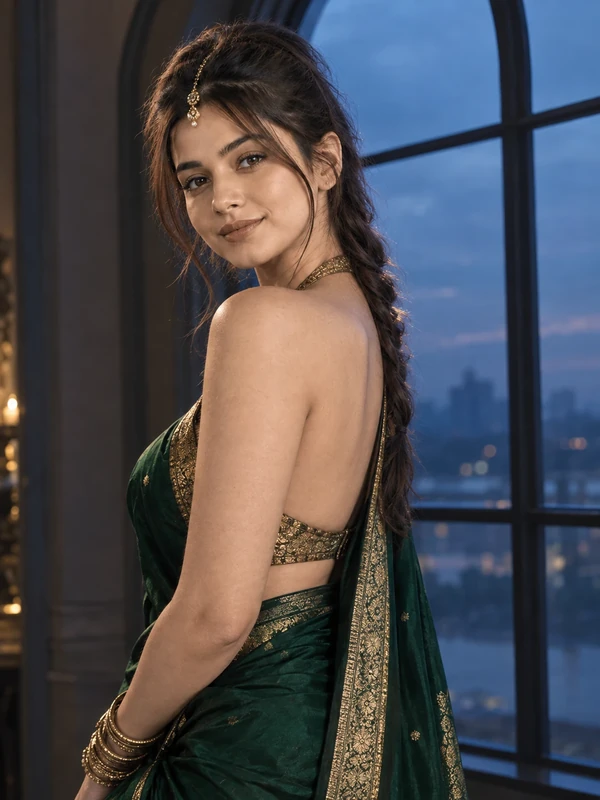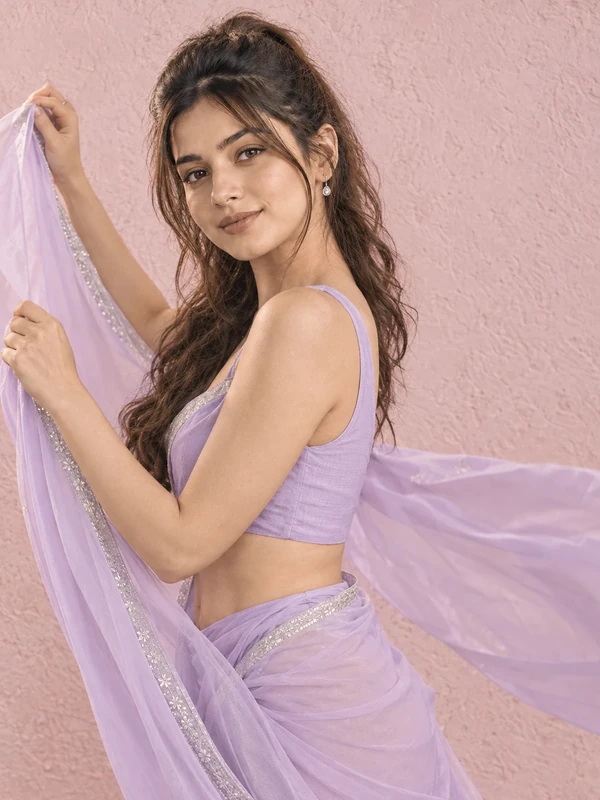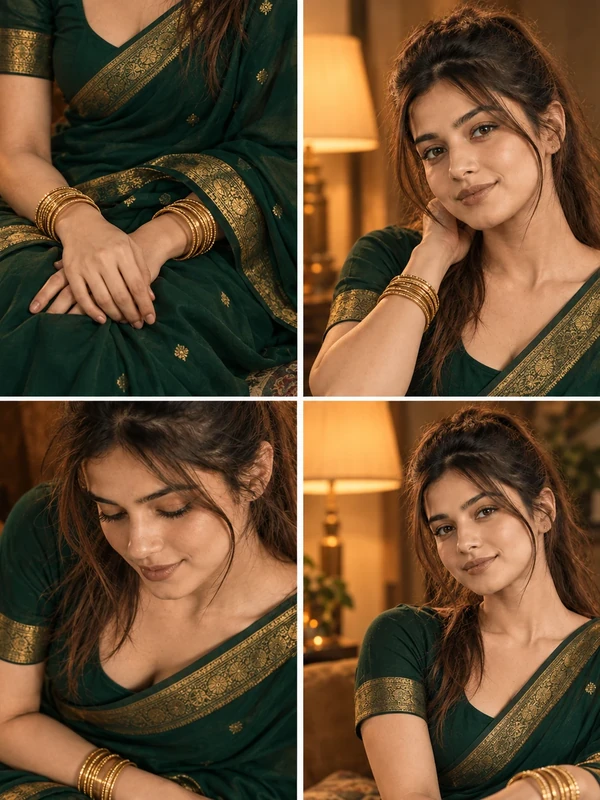
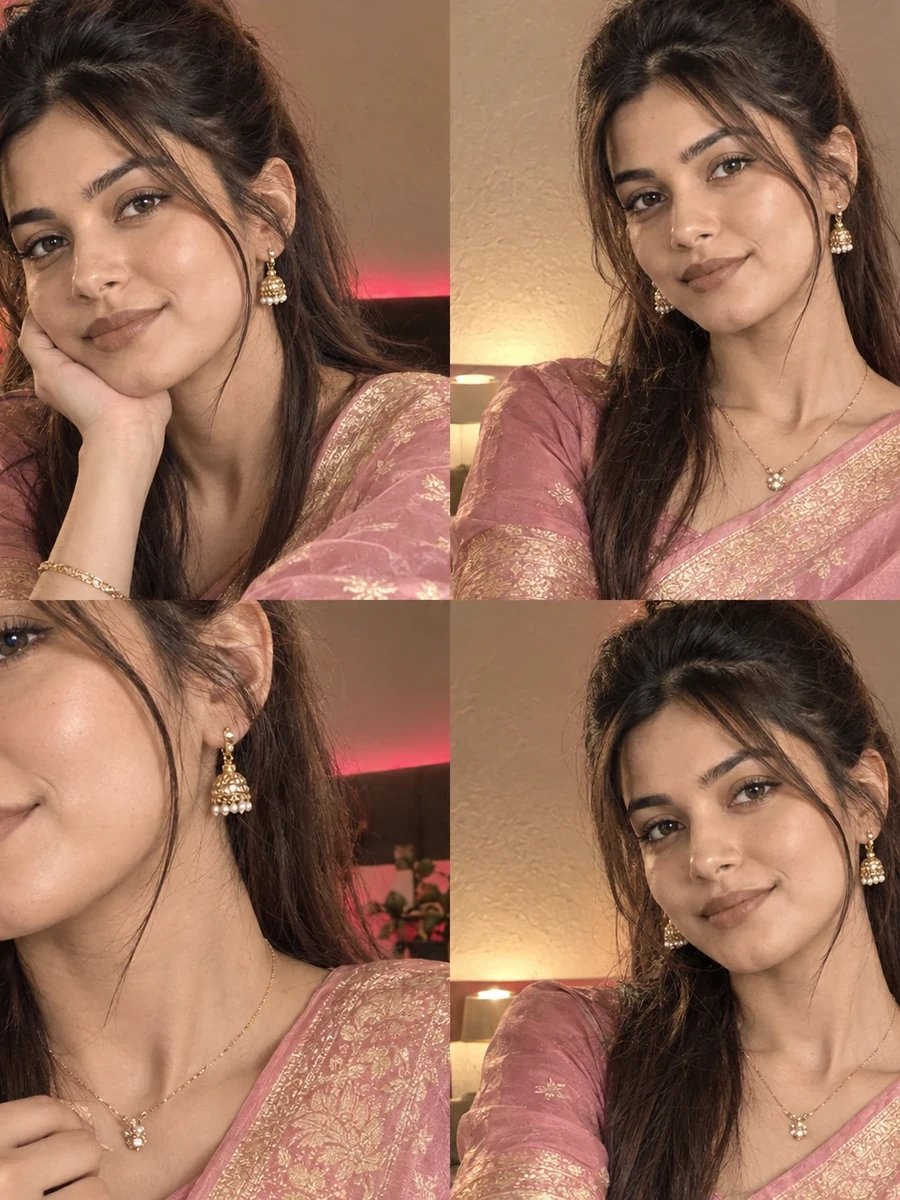
This free saree selfie prompt turns your photo into a 2x2 grid of four coordinated iPhone-style selfies — a blush pink Banarasi silk saree with gold zari borders, shot in warm indoor lighting with subtle pink-red LED accents. This format has become a popular aesthetic for saree photos precisely because it mimics how people actually take selfies in real life: a mix of close-up angles, jewelry details, and candid half-smiles, rather than one formal, single portrait.
What makes a four-frame grid prompt harder to get right than a single image is consistency — the same face, the same outfit, the same lighting mood needs to hold across all four frames, or the collage looks obviously artificial. This prompt is written to reinforce that consistency explicitly, treating the four frames as variations of the same real photoshoot moment rather than four independent generations.
How to Use This Prompt
1. Copy the full prompt above. 2. Open ChatGPT, Gemini, or any AI image tool that supports image uploads. 3. Upload one clear, front-facing photo of yourself. 4. Paste the prompt exactly as written and send it. 5. The AI will generate a 2x2 grid of four selfie-style frames using your actual face, styled in the blush pink saree described above. 6. If any single frame looks inconsistent with the others, ask the AI to "regenerate frame [number] to match the same face, lighting, and saree styling as the other three frames."
This prompt is the first in a five-part saree selfie collection — try the maroon or peacock teal variants next for a coordinated set of festive selfie grids.
Why Face Preservation Matters Here
Multi-frame collages multiply the risk of facial drift — if even one of the four frames looks noticeably different from your actual face, the whole grid feels off, since viewers naturally compare the frames against each other. This prompt's facial identity instructions explicitly apply "across all four frames," which is necessary because some AI tools treat each frame in a grid as a semi-independent generation and can introduce small inconsistencies without that instruction.
If you notice one frame looking less accurate than the others, it's more effective to ask for that specific frame to be corrected rather than regenerating the whole grid — for example, "only the jewelry close-up frame needs adjustment, keep the other three frames as they are."
Who This Prompt Works Best For
This blush pink grid is a strong choice for anyone who wants their saree photos to look like a real, spontaneous selfie session rather than a formal studio portrait — it works well for Instagram carousels, WhatsApp status updates around a festival, or a wedding guest look shared casually rather than posted as a single formal image. The soft, warm palette and iPhone-style framing also make it a good opener if you're generating multiple saree grids in one sitting, since the lighter tone provides a gentle contrast to the deeper maroon and emerald options later in the collection.
It's a less suitable pick if you need one single, high-impact image rather than a four-part collage — the visual appeal here comes specifically from the grid format and the variety across frames, so if you only need one photo, a single-frame saree prompt will be a more direct fit.
Common Mistakes to Avoid
The most common mistake with any grid prompt is uploading a reference photo that's too tightly cropped — since the AI needs to generate four different framings (chin-on-hand, direct front-facing, jewelry close-up, candid half-smile) from one source image, a reference photo that only shows your face from the nose up limits how well it can extrapolate the wider frames. Another frequent issue is expecting all four frames to render in a single attempt without needing any follow-up; it's normal and expected to need at least one round of frame-specific correction, especially for the jewelry close-up, which asks the AI to render fine detail it doesn't have direct reference for. Finally, avoid reference photos with strong colored lighting already on your face (a green or blue tinted room, for example) since that can conflict with the requested warm pink-red LED accent tone and create an odd double-lighting effect in the final grid.
Tips for Best Results
- Use a well-lit, front-facing reference photo — grid-style prompts rely heavily on the AI extrapolating your face from multiple angles, so a clear starting reference matters more here than in single-frame prompts.
- If the LED accent lighting looks too intense, ask for "more subtle pink-red LED accents, warm tones should still dominate" in a follow-up.
- Try both ChatGPT and Gemini — multi-frame grid consistency is one of the more noticeable differentiators between AI tools.
- For jewelry-focused frames, mention "sharp, detailed focus on jewelry texture and reflections" if that frame looks too soft.
- If you're building a full saree selfie set, this blush pink grid works well as an opener alongside the deeper maroon and emerald tones later in the collection.