પ્રોમ્પ્ટ
FACIAL IDENTITY — ABSOLUTE PRIORITY
Keep the uploaded person's face completely unchanged: same bone structure, same eyes, same nose, same lips, same skin tone and texture. Do not slim, smooth, beautify, reconstruct, or reinterpret the face. Do not turn them into a celebrity or generic model. 100% face match to the reference photo — only the outfit, pose, background, and gaze direction change, never the face itself.

CAMERA-FACING ANGLE & DIRECT EYE CONTACT (critical)
Face stays fully forward and centered toward the camera, head level, not tilted or turned away — even during an action pose (riding, walking, holding something). The action comes from the hands, shoulders, and body only, never from turning the head or face.

Both people's pupils are centered and looking straight into the camera lens — direct eye contact with the viewer, like a portrait photographer's direct-gaze shot. Not gazing to the side, not looking past the camera into the distance, not unfocused, not cross-eyed. Even if the uploaded reference photo shows the eyes looking elsewhere (to the side, downward, at each other), redirect the gaze so both people look straight into the camera in the final result — this is the one detail that is allowed to differ from the reference photo.

HAIRSTYLE
Hair is neatly styled and groomed for the scene — flyaways smoothed down, settled, not messy or windblown. Applies to both the man and the woman.

MAKEUP (for female subjects)
Light, natural, everyday makeup — subtle base, softly defined brows, a natural lip tint, and a healthy glow. For male subjects: neatly groomed hair and clean natural skin texture, no visible makeup.

CLEAR SKIN (both subjects)
Both people's skin is clear and even-toned — pimples, acne, blemishes, and dark spots are smoothed away naturally, while keeping real, natural skin texture (visible pores, no plastic or airbrushed look). This applies equally to the man and the woman.

IMPORTANT: This grooming, makeup, skin-clearing, and gaze-redirect enhancement must never change face shape, eyes, nose, lips, or bone structure — it only enhances the existing face and gaze direction, it does not alter identity.

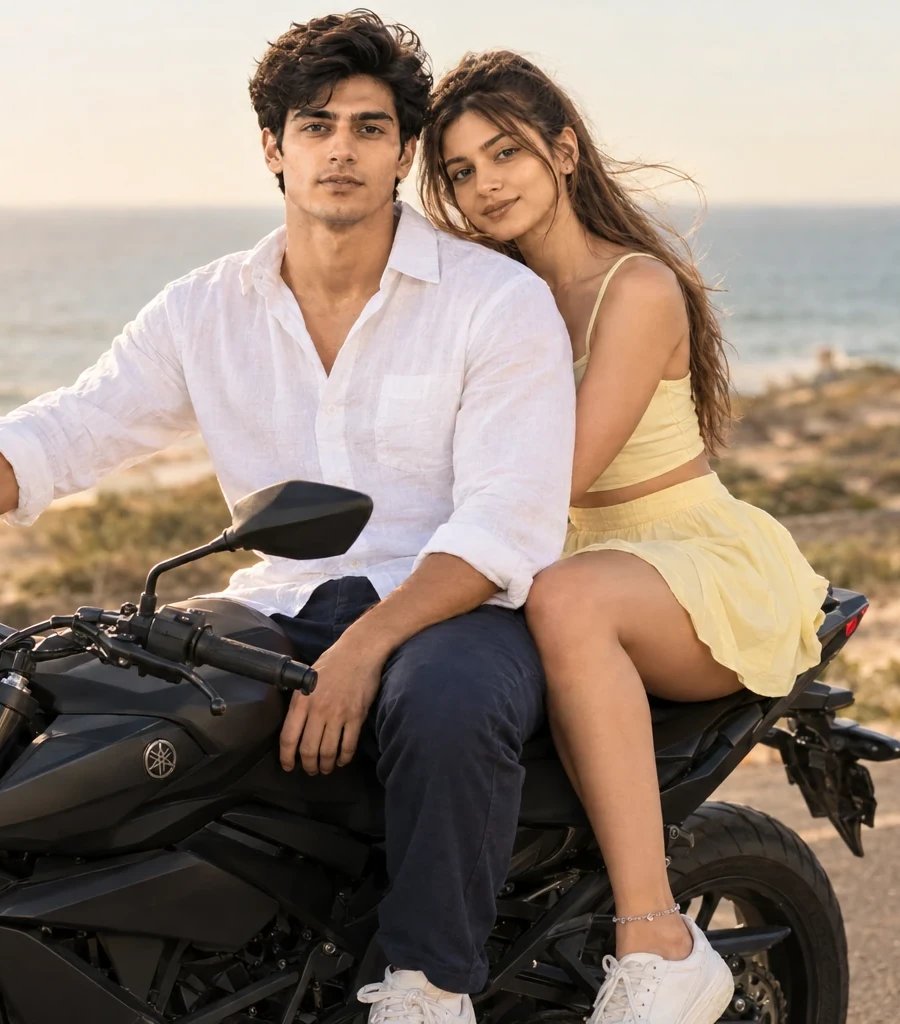
A warm coastal afternoon is already painting the scene gold when the couple steps into frame — the young Indian man seated confidently on a matte black naked sports motorcycle, his face completely faithful to the reference photo with no changes to his facial structure, skin tone, eye shape, beard, or natural expression whatsoever. He wears a crisp white oversized linen shirt tucked loosely into straight-cut dark navy chinos, white chunky sneakers grounding the whole look. Behind him, she sits close, dressed in a Pinterest-inspired pastel yellow co-ord set, a short flowy skirt skimming just above the knee, a fitted crop top, silver anklet catching the light. Her long open hair lifts slightly in the ocean breeze. Both faces are turned toward the camera, soft candid smiles, not posed, just real. The scene is set on a coastal road with pale sand dunes visible in the background, sea glinting softly far behind, a calm clear sky overhead. Shot on a Canon EOS R5 at 85mm f/1.8, ISO 200, the background melts into creamy bokeh while both faces stay razor sharp. Color grading is warm coastal editorial, soft whites, sandy tones, a whisper of teal. This is a google gemini couple photo editing prompt built for Pinterest feeds. Full fashion editorial treatment, elegant and refined, completely platform-safe, natural beauty forward, high-end magazine quality lighting and finish.
આ પ્રોમ્પ્ટ શું બનાવે છે
Couple photos are a different problem than solo portraits — you're not just protecting one face, you're protecting two, and they need to stay consistent with each other in the same frame. This prompt handles that by putting a couple on a matte black sports motorcycle on a coastal road, gold afternoon light, pale sand dunes behind them, both faces turned toward the camera with soft, candid smiles that aren't meant to look posed.
What's asked for here specifically is that both faces stay razor sharp while the background melts into bokeh — which is a nice effect when it works, but it also means there's nowhere for either face to hide if something's slightly off. Unlike a solo shot where you're checking one set of features, you're now comparing two people's faces against two separate reference photos, so it's worth reviewing both carefully rather than glancing at the overall composition and calling it done.
The outfits are deliberately relaxed — white linen shirt and navy chinos for him, a pastel yellow co-ord set for her — nothing formal, which fits the coastal, unposed mood the prompt is going for. If either outfit renders a bit generic or simplified, naming the specific missing detail ("add the silver anklet, it's missing") tends to get better results than asking for the whole look to be redone.
This works well for an engagement-style post, an anniversary photo, or just something playful for a couple's shared account — the mood here is warm and unbothered rather than formal or staged. It's less suited if you want something moodier or more dramatic; the night city shore prompt later in this collection leans into that instead.
One practical note for couple prompts generally: if you're uploading two separate reference photos, make sure they're reasonably similar in lighting quality and resolution. A sharp, well-lit photo paired with a blurry one tends to produce an uneven result where one person looks more accurately rendered than the other.
The gold afternoon light described here is doing more than just setting a mood — it's the thing that makes the bokeh transition from sharp faces to soft dunes feel natural rather than artificial. Harsh midday light tends to flatten that transition, while the warmer, lower-angle light this prompt calls for gives the background more of a gradual, photographic falloff. If your result comes back looking a bit clinical, with the background too evenly blurred rather than warmly hazy, asking for "warmer golden-hour tone in the background blur, less clinical bokeh" is a more targeted fix than asking for the lighting to be redone from scratch.
Worth thinking about too is how this compares to the eucalyptus road prompt later in this same collection, since both go for a relaxed, sunlit coastal mood with a similarly loose outfit style. The real difference is candid versus composed — this one is built around unposed, in-the-moment expressions, while the eucalyptus shot leans into a calmer, more deliberate asymmetry between the two people. If you're deciding which one to generate first, this coastal wind version is the better opener precisely because it's the most forgiving to review: both faces are looking straight at the camera in even light, which makes it the easiest of the five to judge for accuracy before moving into the trickier composed or low-light prompts later in the set.
One more thing worth trying if the pastel yellow co-ord doesn't render with quite the right saturation: pastel tones are notoriously tricky for AI models, since they sit in a narrow space between "washed out" and "true color," and it's easy for a generation to drift toward one or the other. A follow-up like "keep the yellow soft and pastel, not muted grey and not fully saturated" gives the model a clearer target than just repeating "pastel yellow" again.
If you're generating this as the first image in a broader set for a couple's account, it's worth thinking ahead about consistency in the bike itself. This one features a matte black naked sports motorcycle, while other prompts in the collection use everything from a forest green Classic 350 to a sand-colored Meteor — if the goal is a cohesive feed where the same bike appears across several posts, this prompt isn't the one to pair with the others unless you're comfortable with the bike changing between shots, since each prompt in this set was written around a different specific model rather than a shared one.
It's also worth glancing at how the sand dunes behind you are described, pale and softly out of focus rather than sharply detailed, since that's a deliberate choice to keep the eye on the two of you rather than the landscape. If you want a version with a stronger sense of place, that's a reasonable follow-up to ask for, but it's worth knowing you're trading some of that intimate, closed-in feeling for a wider, more scenic result — the two effects don't really coexist in the same generation.