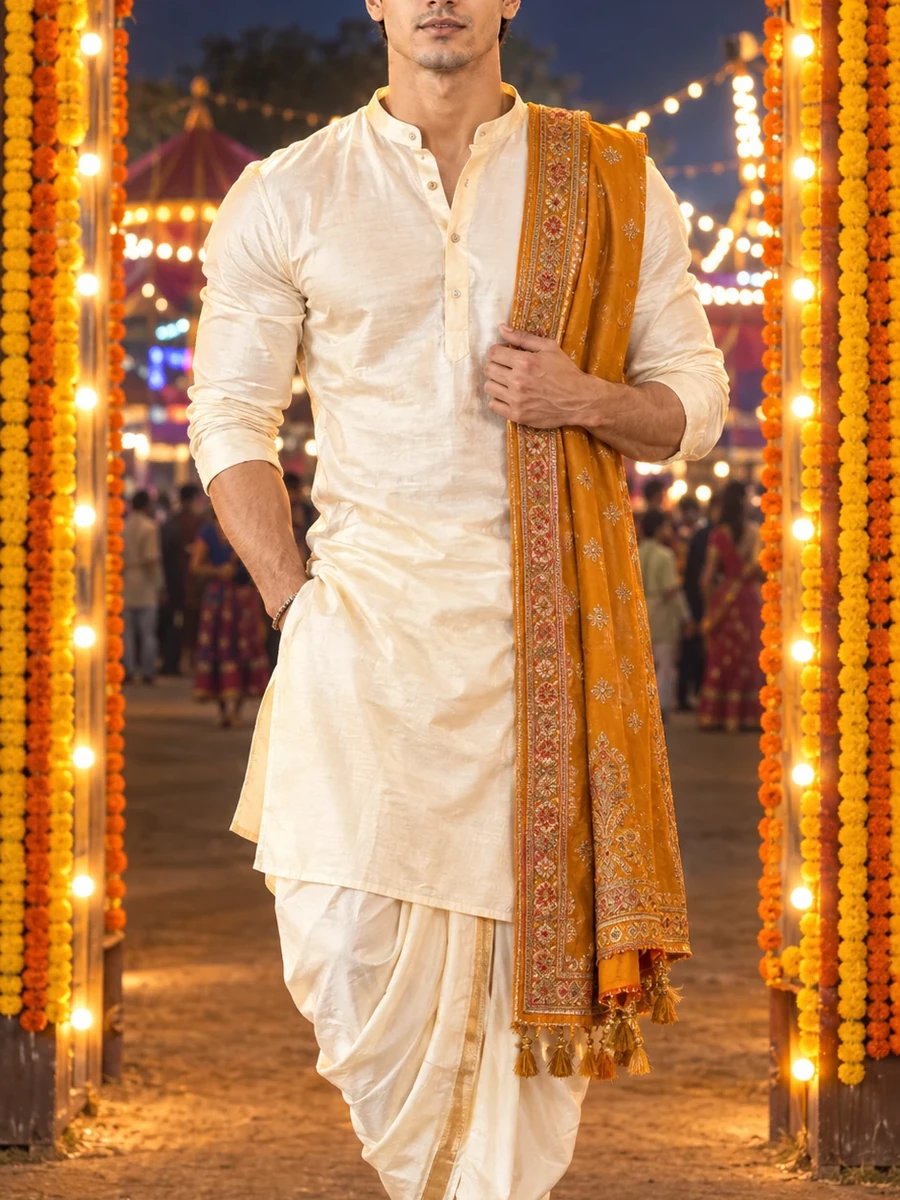
This free Navratri prompt turns your photo into an editorial-style full-body fashion portrait — a cream and saffron silk kurta paired with a tailored dhoti, an embroidered stole draped over one shoulder, standing confidently at the glowing entrance arch of a Garba ground. The scene captures the modern fusion aesthetic many wear to festival nights now: a clean, tailored silhouette rather than traditional draped fabric, warm bulb lighting framing the archway, and a softly blurred crowd and festival lights extending beyond it. This is the most fashion-forward, least dance-focused prompt in the Navratri collection, closer to a magazine street-style shot than a candid festival photo.
The lighting setup here is specifically chosen to create a flattering rim light around the subject's silhouette — warm bulb light from the arch mixing with cooler evening ambient light behind. That rim-light effect is a classic editorial photography technique, separating the subject crisply from the background without needing an artificially blurred backdrop. Combined with the relaxed, confident standing pose and a hand adjusting the stole, the whole composition reads as a deliberate fashion moment rather than a caught-in-the-act candid shot.
How to Use This Prompt
1. Copy the full prompt above. 2. Open ChatGPT, Gemini, or any AI image tool that supports image uploads. 3. Upload one clear, front-facing photo of yourself, ideally one where your face and upper body are both visible for the fullest reference. 4. Paste the prompt exactly as written and send it. 5. The AI will generate a photorealistic Navratri fashion portrait using your actual face, styled in the fusion kurta and dhoti outfit described above. 6. If the rim lighting looks too subtle or too harsh around the silhouette, ask the AI to "adjust the rim light intensity from the archway to be more balanced and natural against the subject."
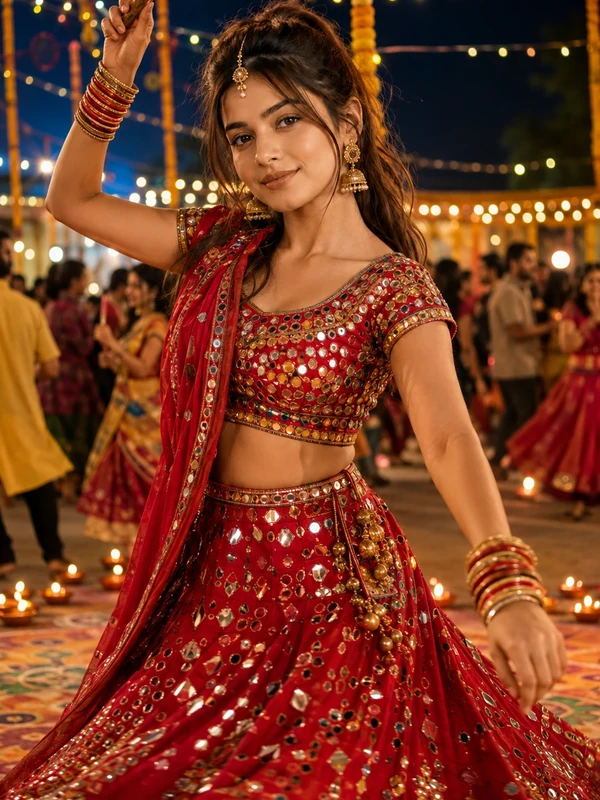
As the most polished, fashion-forward prompt in the collection, this pairs well with the high-energy Kediyu Garba portrait for two contrasting looks — one relaxed and editorial, one dynamic and mid-dance.
Why Face Preservation Matters Here
This prompt is shot as a full-body composition at 24mm, which means the face occupies a smaller portion of the overall frame than in the collection's close-up or waist-up prompts. That can actually work in your favor for facial accuracy, since there's less complex lighting variation directly on the face compared to the diya-lit prompts — but it also means the AI has less visual space to work with when trying to preserve fine facial detail, so a strong, clear reference photo matters just as much here.
The rim-lighting effect, while flattering, does introduce a specific risk: strong backlighting can sometimes push AI models to darken or simplify facial detail to create a more dramatic silhouette effect, at the cost of losing the accuracy the facial identity instructions are meant to protect. If your face looks underexposed or less detailed than in your reference photo, add a follow-up like "keep the face clearly lit and fully visible even with the rim lighting effect, do not let the backlight darken or simplify facial features."
Who This Prompt Works Best For
This editorial fusion portrait is a strong pick for anyone who wants their Navratri photo to look like intentional, styled fashion content rather than a candid festival snapshot — a personal styling post, a polished profile photo, or the closing image in a themed set after more energetic dance-focused portraits. Because the pose and styling lean modern rather than strictly traditional, it also works well for anyone wearing contemporary fusion wear to an actual celebration and wanting a photo that matches that aesthetic.
It's a less ideal choice if you specifically want to capture the dance itself — this is the most static, composed prompt in the collection, so if energy and motion matter more to your image, the Chaniya Choli twirl or Kediyu clapping portraits will serve that purpose better.
Common Mistakes to Avoid
Because this is a full-body composition, a common mistake is uploading a reference photo that only shows your face and shoulders — since the AI needs to extrapolate your full body proportions from a face-focused photo, a reference that includes at least your upper body gives more accurate results. Another frequent issue is expecting the rim-lighting effect to look balanced without any adjustment; strong backlighting is genuinely tricky to get right, so it's worth reviewing whether the face looks appropriately lit rather than accepting an overly dramatic silhouette on the first attempt. Finally, avoid vague follow-up requests when the embroidered stole or dhoti tailoring looks off — naming the specific garment and detail you want corrected gets a far more useful result than a general regeneration request.
Tips for Best Results
- Use a well-lit, front-facing reference photo for the most accurate face match, ideally one that also shows your shoulders and upper body since this is a full-body composition.
- If the AI changes your face too much, add: "keep the face 100% identical to the uploaded photo, do not simplify or darken facial features for the rim-light effect."
- Try both ChatGPT and Gemini — results can vary slightly between tools, particularly in how each renders rim lighting and silhouette separation.
- If the embroidered stole or dhoti tailoring looks inconsistent, ask for "sharp, well-defined embroidery detail and clean tailored lines on the dhoti and stole."
- If you're building a full Navratri set, this polished fashion portrait works well as a closing image after the more energetic Garba and diya-lit portraits earlier in the collection.